
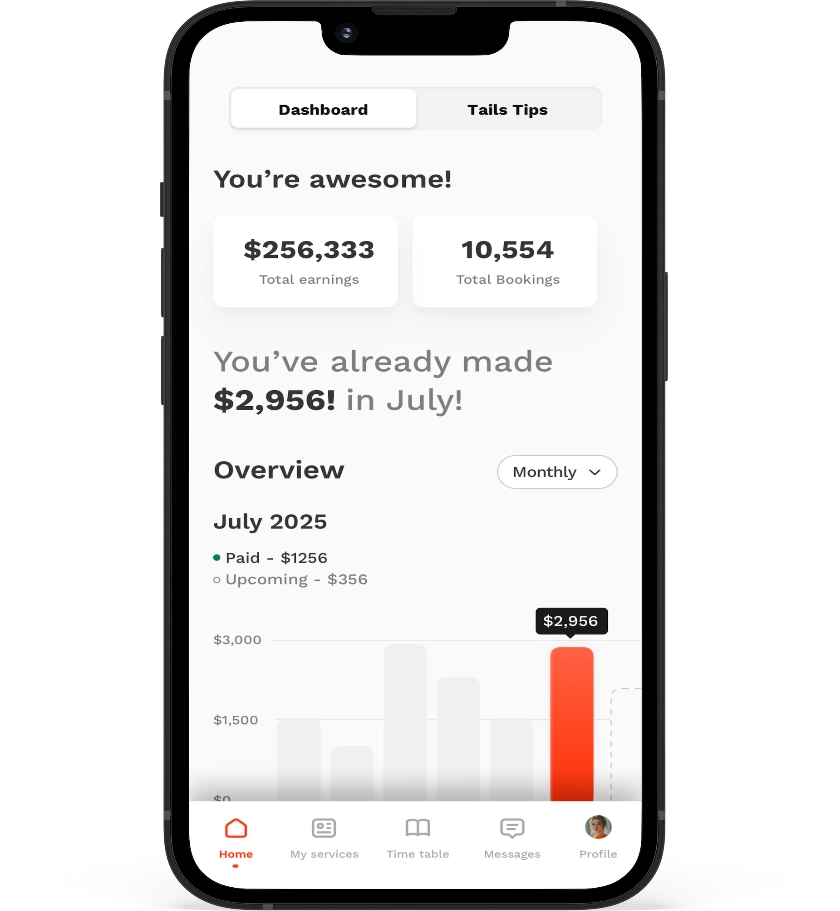
Chicago dog walker income depends less on hours worked and more on what percentage you keep from each booking. If your platform takes 20-40%, your ceiling drops even with a full calendar.
This guide breaks down take-home math and the specific changes that move providers from gig pay to career-level earnings.
The Math: Same Walk, Double the Take-Home
Let's cut to the numbers. Here's what happens to a $25 walk on each platform—including what the pet parent actually pays:
| Platform | Your Rate | Provider Fee | Client Service Fee | Total Platform Take | Client Pays | You Keep |
|---|---|---|---|---|---|---|
| Wag! | $25 | 40% ($10) | — | 40% ($10) | $25 | $15 |
| Rover | $25 | 20% ($5) | 11% ($2.75) | 31% ($7.75) | $27.75 | $20 |
| Tails | $25 | 10% ($2.50) | 5% ($1.25) | 15% ($3.75) | $26.25 | $22.50 |
Tails takes less than half of what Rover takes (15% total vs 31% total). You keep $22.50 instead of $20—and the client pays $1.50 less than on Rover. Everyone wins except the platform shareholders.
That's 50% more than Wag! on every single walk. Same work. Same client. Same dog. If you ignore the fee structure, you're donating $7.50 of every walk to a company that didn't show up.
Now multiply that across a week:
| Platform | 25 Walks/Week | You Keep | Weekly Take-Home |
|---|---|---|---|
| Wag! | $625 | 60% | $375 |
| Rover | $625 | 80% | $500 |
| Tails | $625 | 90% | $562.50 |
Now scale that across a full year of work—25 walks a week, plus boarding and holiday surges—and the gap becomes impossible to ignore:
Same Work. Different Take-Home.
What you actually keep from $39,700 in annual billings
The platform you choose is a $4,700–$8,300 decision every year.
That's not a bonus—that's money you already earned but gave away to a fee structure you didn't question.
Run your own numbers: Use our earnings calculator to see what you could make based on your schedule and service mix.

Stop Letting Apps Steal Your Margins
Here's the truth nobody in the gig economy wants you to understand: you are the product, not the customer. Gig apps monetize your labor to their shareholders—when their fee structure changes, you absorb the loss; when their algorithm shifts, your bookings disappear.
Most apps don't just take from you—they take from both sides. Rover charges you 20% AND charges pet parents an 11% service fee. That's 31% total extracted from every transaction. Wag! takes 40% directly from your earnings. You did the walking. You braved the Chicago winter. You built the relationship with that dog. And then an app takes a third of the transaction value for connecting you once to a client you'll serve for years.
If you earn $50,000 gross on a standard platform, you hand them $10,000 to $20,000 annually. That's the cost of a new car, every single year. That's money you earned with your feet, your time, and your expertise—transferred to a company that did nothing after the initial match.
This is frustrating—and it's also fixable. We know the stress of watching a $30 walk become $18 after fees. We know the anxiety of wondering if you'll have enough bookings next week because an algorithm controls your visibility. That's why Tails exists: a platform that works for you, not off of you.
The Tails Difference:
- We charge 15% total (10% from providers + 5% from clients)—less than half of Rover's 31%. You keep 90% of your rate because you earned it, and clients pay less than they would on Rover.
- Price Floors: We don't let providers undercut the market. Without price floors, desperate newcomers drive rates down until nobody can make a living. Price floors protect the profession's value—and your income.
- No Algorithm Games: We match based on verified skills, not who's willing to charge the least. If you can handle leash-reactive dogs, clients who need that skill find you—regardless of how cheap someone else is willing to go.
How to Earn More Per Walk (The "Pro Rate")
Keeping 90% is step one. Step two: charge more. You're not doing anything wrong if you're stuck at $20/walk—you just need skills that justify higher rates.
In 2026, the baseline rate for a 30-minute walk in Lincoln Park, Wicker Park, or Lakeview is $20-$25. That's the "Going Rate"—what you charge when you're competing with every college student with a leash. At that rate, you cap out around $25k/year net even with full schedules.
The "Pro Rate" is $25-$30 per walk. The difference comes from specialized skills that amateurs cannot safely provide:
| Skill | What It Means | Why Clients Pay More |
|---|---|---|
| Behavioral Expertise | Handling leash-reactive dogs | Amateur walkers cannot safely manage reactivity—one wrong move triggers a bite, a lawsuit, and a traumatized dog. Owners of reactive dogs pay premiums because they cannot afford a mistake. |
| Medical Care | Administering insulin or oral meds | Senior dogs need precise dosing on exact schedules. Miss a dose or give the wrong amount, and the dog ends up at the emergency vet. Owners pay for peace of mind because the alternative is catastrophic. |
| Puppy Development | Structured walks that reinforce training | Puppies who don't learn leash manners in months 3-6 become leash-reactive adults. Owners pay now to prevent $3,000+ in behavioral training later. |
When you develop specialized skills, you stop competing on price. Clients who need behavioral expertise or medical care don't haggle over $10—they pay for competence because the cost of incompetence is much higher.
The combined effect: A specialist on Tails charging $30/walk keeps $27. A gig worker on Wag! charging $20/walk keeps $12. That's more than 2x the take-home on every walk—because you're earning more AND keeping more. Over 25 walks/week, that gap becomes $375/week or $19,500/year.
Real Expenses to Plan For
Running a business isn't free. If you ignore these costs, you'll think you're earning $40k and end up with $25k. Budget like a pro from day one.
Transportation ($150-$400/mo): Chicago is big. Smart walkers "cluster" their routes within a single neighborhood. If you service both Lincoln Park and Hyde Park, you're burning $200+/month in gas and 10+ hours/month in unpaid drive time. Pick a zone and own it—or accept that scattered clients cost you money.
Gear ($50/mo): In Chicago, "bad weather" lasts 5 months. You need professional-grade waterproofs, slip-resistant boots, and backup leashes. A Polar Vortex doesn't care about your schedule—but your clients will remember you showed up when others canceled. That reliability is how you earn repeat bookings and referrals.
Taxes (25%): As an independent contractor, taxes aren't withheld from your payments. If you spend everything you earn, you'll owe the IRS thousands in April with no way to pay. Set aside 25-30% of every payment for federal, state, and self-employment taxes. Open a separate savings account and transfer immediately—this is non-negotiable.
How to Scale to Six Figures
Can you really make $100k walking dogs? Yes, but not by walking alone. The math doesn't work—there aren't enough hours in a day. Top earners on Tails stack their income across multiple service types:
The Base: Recurring mid-day walks (M-F) cover your fixed expenses. This is your foundation—reliable clients who book weekly and trust you with their keys. Without this base, you're constantly scrambling for new clients instead of growing.
The Multiplier: Boarding and Sitting. Hosting one dog for a weekend nets $150-$200 while you sleep, eat, and live your life. Doing that twice a month adds $5,000 to your yearly bottom line with minimal additional work hours.
The Holiday Surge: Holiday rates in Chicago hit $60-$80/visit because demand spikes and supply drops (most walkers take time off). Thanksgiving week, Christmas through New Year's, and summer travel season are when professionals make their margin. If you skip holidays, you leave thousands on the table. Pros plan their year around these peaks.
Here's what those three streams look like stacked together:
Stack Your Income
Three revenue streams that work together to build a sustainable pet care business
Base Walks
25 walks/week × $25 · Mon–Fri
$32,500
Weekend Boarding
2 dogs/month × $175 · Passive income
$4,200
Holiday Surge
$60–80/visit · Thanksgiving, Christmas, summer
$3,000
Annual Net Income
$0
Tails
$32,130
Rover
~$27,400
Wag!
~$23,800
With consistent bookings and premium clients, walkers regularly scale to $45,000+ while maintaining work-life balance.
That's over $32,000 net working 5-6 hours per day—more than most full-time retail or food service jobs, with complete schedule control.
Want to model your own scenario? Try our interactive earnings calculator to see how different service mixes affect your bottom line.
The Choice in Front of You
If you want easy money, this isn't it. You will walk in 15-degree wind chills in February—because dogs need walks regardless of weather. You will clean muddy paws and manage complex schedules. You will build something real.
But here's the question: Do you want to stay an employee of an algorithm, or become the owner of your own career?
The gig app model has a ceiling: you'll never earn more than 60-80% of what you bill, your visibility depends on algorithmic favor, and your client relationships belong to the platform. If that algorithm changes tomorrow, your income disappears.
The Tails model removes that ceiling: you keep 90%, your skills determine your rates, and your client relationships are yours. The tradeoff is accountability—you have to show up, develop expertise, and run your business like a business.
Stop treating your work like a side hustle. Stop letting platforms take 40% of what you've earned. Stop competing on price with people who don't take this seriously.
The dogs are waiting. The premium clients are actively looking for someone with real skills. And the 90% take-home is yours—if you're willing to earn it.
Don't just walk dogs—build a career you actually own.
Frequently Asked Questions
How much do dog walkers make outside Chicago?
Nationally, income ranges from side-income levels to full-time professional earnings depending on client consistency, city density, and how much the platform takes in total fees. Chicago tends to support stronger route density and higher recurring volume than many smaller markets, which is why this guide uses Chicago as the reference model.
How quickly can I start earning?
On most apps, you wait weeks for a "match" while the algorithm decides if you're worthy—and that wait time has no clear end. On Tails, if you have verified skills (like medical administration or puppy care), our system actively matches you with clients who need those specific skills. Most skilled providers see bookings in their first week because we're not waiting for an algorithm to "discover" you.
Do I need a car?
In dense neighborhoods like River North, Gold Coast, or Wicker Park, walkers successfully use bikes or scooters—travel distances are short and parking is expensive. However, without a car, you cannot serve suburban clients or quickly pivot when a regular cancels. In winter, a car becomes essential: biking in a Polar Vortex isn't just uncomfortable, it's dangerous and slow. The tradeoff: car walkers have higher expenses but access more clients and higher reliability.
What if I don't have professional experience yet?
Don't fake it—clients and dogs can tell, and a bad incident ends your career before it starts. Instead, volunteer at Chicago shelters like PAWS Chicago or Anti-Cruelty Society. Shelter dogs present challenges you'll never encounter walking a neighbor's well-trained Golden Retriever: leash reactivity, resource guarding, fear aggression, and medical needs. That experience counts as "Professional History" on Tails, and it's experience that separates you from every other new walker.
Why is the Tails fee so much lower?
Our total take is 15% (10% from providers + 5% from clients)—less than half of Rover's 31%. That 15% covers what we actually do: run the platform, vet clients, provide insurance, and handle payments. We refuse to take a third of every transaction for work we didn't do. The 31-40% model exists because venture-backed apps need to show massive revenue growth to investors—and that revenue comes directly from your earnings and your clients' wallets. We're not playing that game.
Can I do dog walking alongside another job?
Absolutely. Many Tails providers walk dogs during lunch hours, before or after traditional work schedules, or on weekends. The flexibility is real. But here's the constraint: dogs need consistency. If you commit to Tuesday/Thursday walks and then cancel because your other job needs you, you'll lose that client. Be realistic about your availability when building your client base—consistent availability builds trust, and trust builds recurring income.