After orthopedic surgery, the repair is only as strong as your next 8-16 weeks of routine. This guide shows how to run truly controlled recovery walks, prevent costly setbacks, and screen caregivers who can protect healing tissue instead of accidentally undoing it.
Post-Op Walk Control Scorecard
| Element | Pass Standard | Fail Signal |
|---|---|---|
| Leash control | 4-6 foot leash with proactive trigger avoidance | Retractable leash or late reactions to triggers |
| Surface choice | Dry, flat, predictable route every walk | Grass, gravel, icy patches, or stairs |
| Time control | Walk length follows current rehab week exactly | "Extra minutes because they seemed fine" |
| Behavior management | No greetings, no play, no off-leash time | Allows excitement spikes or rough interaction |
| Monitoring | Logs incision status, gait changes, and recovery regressions | No structured post-walk observation |
Why Is Orthopedic Recovery So Strict?
Different surgeries have different recovery timelines, but they share one principle: bone requires mechanical stability to heal. Violate that stability—through jumping, running, or even a sudden lunge—and you risk delayed healing, implant failure, or re-injury requiring additional surgery.
The Bone Healing Timeline
The Bone Healing Phases
Each phase allows more activity — but pushing too fast resets the clock to week zero.
Strict Rest
Weeks 0 – 2Critical — highest risk
Inflammation phase. Crate rest with potty-only outings. The surgical site is held together by sutures and hardware alone — no bone bridge exists yet.
Early Formation
Weeks 2 – 4High risk — bone callus forming
Early bone formation begins. The callus is fragile — like a green twig that can bend and break. Very short controlled walks with strict pace control.
Callus Strengthening
Weeks 4 – 8Moderate risk — building strength
Bone callus is forming and gaining strength. Gradual increases allowed, but the bridge is not yet strong enough for impact or sudden forces.
Remodeling
Weeks 8 – 12Lower risk — still controlled
Bone is remodeling and gaining real strength. Longer walks are possible, but triggers (other dogs, squirrels) still pose a threat — one explosive lunge can stress hardware.
Return to Normal
Weeks 12 – 16+Near full healing — gradual freedom
Near-full healing confirmed by X-rays. Gradual return to normal activity per your surgeon’s guidance — not your dog’s enthusiasm.
Your dog will act ready before they are. Dogs mask pain by instinct. Given the chance, a dog at week 6 will sprint, jump, and play — and undo everything. Follow your surgeon’s timeline, not your dog’s enthusiasm.
These are general guidelines. Always follow your surgeon’s specific instructions — your dog’s age, size, and healing progress determine the real timeline.
| Week | What's Happening | Activity Level | What Happens If You Push It |
|---|---|---|---|
| 0-2 | Inflammation, initial healing | Strict crate rest, potty walks only (2-5 min) | Suture failure, incision opening, infection risk |
| 2-4 | Early bone formation begins | Very short leash walks (5-10 min, 2-3x daily) | Bone callus disruption—healing restarts from zero |
| 4-8 | Bone callus forming, strength increasing | Gradual increase (10-15 min walks) | Partial callus fracture requiring extended recovery |
| 8-12 | Bone remodeling, gaining strength | Longer walks (20-30 min), still controlled | Implant stress that can cause hardware failure |
| 12-16+ | Near-full healing | Gradual return to normal activity (per vet guidance) | Re-tear of the repair—back to surgery |
Important: These are general guidelines. Your dog's specific timeline depends on their surgery, age, size, and healing progress. Always follow your surgeon's specific instructions.
Common Orthopedic Surgeries
| Surgery | What It Treats | Typical Recovery |
|---|---|---|
| TPLO | Torn cranial cruciate ligament (ACL) | 12-16 weeks |
| TTA (Tibial Tuberosity Advancement) | Torn cranial cruciate ligament | 10-14 weeks |
| FHO (Femoral Head Ostectomy) | Hip dysplasia, hip fracture | 8-12 weeks |
| Total Hip Replacement | Severe hip dysplasia | 12-16 weeks |
| Fracture Repair (plates, pins) | Broken bones | 8-16 weeks (varies by location) |
| Spinal Surgery (IVDD) | Disc herniation | 6-12 weeks |
| Luxating Patella Repair | Dislocating kneecap | 8-12 weeks |
Why Controlled Activity Matters
Bone doesn't heal like skin. Skin regenerates in days; bone requires 8-16 weeks of mechanical stability. Disrupt that stability, and the bone callus (the bridge forming between broken ends) fractures or fails to form—resetting your recovery timeline to week zero.
Every time your dog:
- Jumps → Puts shearing force on the surgical site, which can bend or break metal implants
- Runs → Creates 2-3x body weight impact forces the healing bone cannot absorb
- Plays rough → Risks direct trauma that can shift bone fragments out of alignment
- Slips on a surface → Twists the joint in directions the repair wasn't designed to handle
- Pulls on the leash → Loads the limb with sudden force before the bone can bear weight
...they risk delayed healing, implant failure, or re-injury that requires additional surgery costing as much as the original procedure.
Your vet isn't being paranoid. They've seen dogs at week 10 come back with re-torn ligaments because someone thought "just a little play" would be fine. It wasn't.
What Does a Controlled Recovery Walk Actually Look Like?
"Controlled walking" doesn't mean "regular walking but shorter." It's a fundamentally different approach.
What "Controlled" Actually Means
| Element | Regular Walk | Controlled Recovery Walk | Why It Matters |
|---|---|---|---|
| Leash | 6-foot or retractable | Short leash (4-6 feet), always taut | Retractable leashes allow lunges before you can react—one lunge can re-tear a ligament |
| Pace | Dog chooses pace | Human sets slow, steady pace | Fast movement creates impact forces healing bone cannot handle |
| Sniffing | Allowed freely | Limited (brief sniffs, no lingering) | Extended sniffing leads to sudden lunges when they smell something exciting |
| Other dogs | Interaction okay | Complete avoidance (cross street, turn around) | Excitement triggers explosive movement no human can physically prevent |
| Surface | Any | Flat, non-slip surfaces only (concrete, dry asphalt) | Grass hides holes; gravel shifts underfoot; both cause slips that stress the repair |
| Direction changes | Dog can pull or explore | Smooth, gradual turns only | Sharp turns put rotational stress on joints the surgery just repaired |
| Duration | Until dog is tired | Strictly timed (per vet instructions) | Fatigue leads to stumbles; a tired dog loses coordination and falls |
The Walk Checklist
Before every recovery walk:
- Check the incision site — Any redness, swelling, discharge, or opening?
- Ensure harness/collar fit — Snug but not tight, no pressure on surgical area
- Survey the route — Avoid stairs, ice, mud, uneven surfaces
- Confirm time limit — Set a phone timer if needed
- Plan for triggers — Know where to go if you see another dog or squirrel
Walking Technique
Start slow. Let your dog find their footing before moving. Recovery dogs often limp or favor the surgical leg—that's normal early on. If you rush the start, they may stumble before they've found their balance.
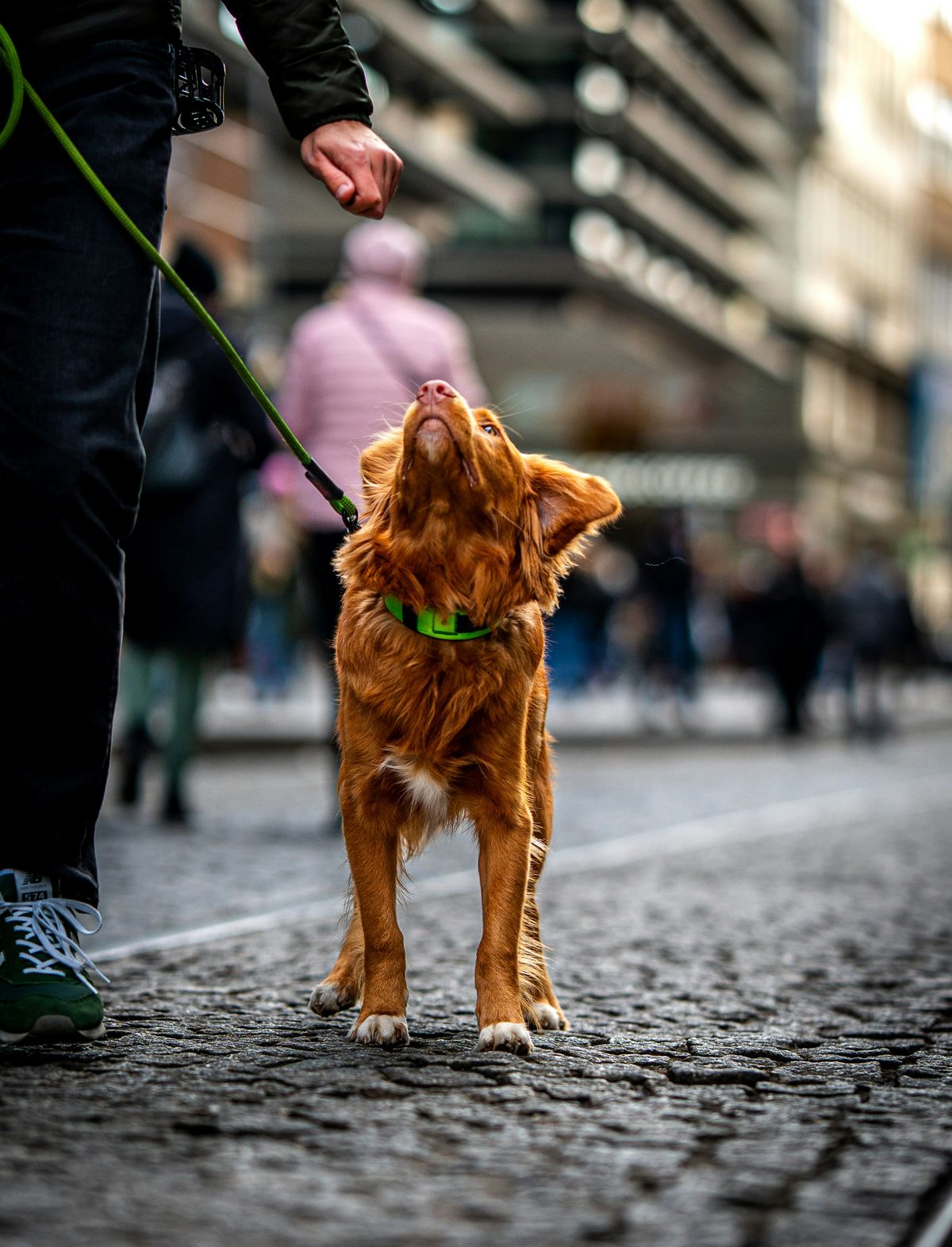
Keep the leash short. Your arm should be relaxed but ready to prevent any sudden moves. The leash should have minimal slack—if your dog can build momentum before you feel tension, you've already lost control.
Set the pace. Walk slowly and steadily. If your dog tries to speed up, slow down or stop completely. You're the metronome; they follow you, not the other way around. A dog who learns they can set the pace will eventually break into a trot—and trotting creates impact forces the surgical site cannot handle.
Avoid triggers. If you see another dog approaching, turn around or step off the path immediately. Don't wait to see if your dog will be calm—by the time you know, it's too late. Excitement triggers an adrenaline response that makes dogs ignore pain signals and move explosively.
Watch the leg. Is your dog using the surgical leg? Toe-touching (light use) is expected early on. But complete non-weight-bearing after week 2-3, when they should be progressing, may indicate implant failure or re-injury—contact your vet.
Stay on flat surfaces. No grass (hides holes and is slippery when wet), no gravel (shifts underfoot and twists ankles), no hills (downhill puts eccentric load on joints the surgery just stabilized). Concrete or dry asphalt is safest.
Chicago-Specific Recovery Challenges
If your dog is recovering from orthopedic surgery in Chicago, you're dealing with environmental hazards that can undo a surgical repair in a single step—hazards that national recovery guides don't address because they weren't written for Midwest winters.
Winter Ice and Salt: The Recovery Killer
Chicago sidewalks from November through March are coated with de-icing chemicals—primarily calcium chloride and magnesium chloride—that create two distinct problems:
1. Slip hazard. A dog 6 weeks post-TPLO who slips on black ice can re-injure themselves instantly. The sudden leg splay puts shearing force on healing bone that can undo everything.
2. Paw irritation. De-icing salt causes chemical burns on paw pads. A dog who's already dealing with surgical pain doesn't need foot discomfort adding to their stress and reluctance to walk.
The Chicago Winter Recovery Protocol
| Element | Standard Advice | Chicago Winter Adaptation | What Happens If You Skip This |
|---|---|---|---|
| Timing | Walk anytime | Walk after 10am when ice has melted; avoid early morning | Black ice at 7am is invisible; one slip can re-tear the ligament |
| Surface | Flat concrete | Only cleared, salted sidewalks; avoid unsalted areas (more ice) | Unsalted areas have smooth ice sheets; salted areas have traction |
| Paw protection | Optional | Required: Apply Musher's Secret 10 min before (it needs to absorb) OR use recovery booties | Salt causes chemical burns on paw pads; a dog in foot pain moves erratically |
| Duration | Per protocol | May need shorter walks in extreme cold; hypothermia adds stress | Cold muscles lose coordination; shivering dogs stumble |
| Post-walk | Quick wipe | Thorough paw rinse with warm water to remove all salt | Salt left on paws gets licked off—GI upset plus continued burning |
The lake wind (Chicago's brutal lake-effect wind) makes winter recovery walks dangerous in a different way. On days with -20°F wind chill, a 10-minute recovery walk becomes a survival calculation: your dog's muscles tense against the cold, their coordination drops, and they're more likely to slip. Discuss with your vet whether skipping walks on extreme days is safer than risking a fall—most surgeons prefer one missed walk over one catastrophic slip.
Chicago Rehab Facilities
If your vet recommends canine rehabilitation (physical therapy), Chicago has excellent options:
| Facility | Location | Specialties | Notes |
|---|---|---|---|
| TOPS Veterinary Rehabilitation | Glenview | Underwater treadmill, laser therapy, post-surgical PT | Well-regarded for TPLO/ACL recovery |
| Chicago Canine Rehabilitation | Lincoln Park area | Post-surgical specialists, land and water therapy | Convenient for North Side |
| Animal Rehab & Wellness Hospital | Wheaton | Comprehensive rehab, acupuncture | Good for West suburbs |
| Integrative Pet Care | Chicago (multiple locations) | Acupuncture, rehab, pain management | Holistic approach |
Ask your surgeon for a referral if insurance coverage is involved. Many orthopedic surgeons have preferred rehab partners they work with regularly.
Building Access During Recovery
If you live in a Chicago high-rise, the walk outside isn't your only hazard—the building itself presents slip risks that can undo a surgical repair before you reach the sidewalk.
- Elevator logistics: A recovering dog who gets excited by another passenger may lunge in a confined space with nowhere to redirect. Ask your doorman to hold a private elevator during your walk times—most buildings accommodate medical recovery requests.
- Lobby floor surface: Marble and polished concrete lobbies are skating rinks for dogs. A single slip on a slick lobby floor puts the same shearing force on the surgical site as a slip on ice. Ask building management about temporary runners or mats—bring a yoga mat yourself if they refuse.
- Stairs as backup: If the elevator breaks, your dog cannot climb stairs—period. Stair climbing puts eccentric load on joints that the surgery just stabilized. Have a carrier ready for small dogs; for large dogs (too heavy to carry), know your building's freight elevator status before you're stranded on floor 30.
The "No" List
During recovery, these activities are absolutely prohibited. This isn't overcaution—each activity creates specific mechanical forces that healing bone and repaired ligaments cannot withstand.
| Activity | Why It's Dangerous | What Happens If You Allow It |
|---|---|---|
| Jumping on/off furniture | Landing creates 2-3x body weight impact on surgical leg | Can fracture healing bone callus or bend metal implants |
| Stairs (unless cleared by vet) | Eccentric loading (muscle lengthening under load) on joints | Stresses repair at angles it wasn't designed to handle |
| Playing with other dogs | Unpredictable movements, excitement overrides pain signals | Dogs ignore injury warnings and move explosively—one tackle ruins months of healing |
| Fetch | Running + sudden stops + jumping = maximum joint stress | Combines every prohibited movement into one activity |
| Tug-of-war | Bracing and pushing with legs creates resistance loading | Puts lateral force on joints that need to stay stable |
| Running/trotting | High-impact repetitive stress on every stride | Each step adds cumulative damage before bone is strong enough |
| Slippery floors | Loss of traction causes leg splay | Sudden leg extension puts shearing force on surgical site |
| Off-leash time | Cannot physically prevent any of the above | One squirrel, one doorbell, one moment of excitement—and it's over |
Even "gentle" play is risky. Dogs don't understand they're injured because instinct tells them to mask pain (showing weakness attracts predators). Given the chance, they'll act like normal dogs—and destroy a surgical repair that took months of recovery and thousands of dollars.
Complications to Watch For
This is the part nobody wants to think about, but catching problems early is often the difference between a minor setback and a second surgery. Your caregiver needs to recognize warning signs and know when to contact you (or go straight to the vet).
Emergency Signs (Contact Vet Immediately)
These signs mean something has gone wrong. Waiting "to see if it gets better" risks turning a manageable complication into a surgical emergency.
| Sign | Possible Cause | What Happens If You Wait |
|---|---|---|
| Incision opening | Suture failure, infection | Bacteria enter the surgical site; bone infection (osteomyelitis) can become untreatable |
| Significant swelling (not just minor puffiness) | Seroma, infection, internal bleeding | Internal bleeding can be life-threatening; infection spreads to bone |
| Discharge from incision (especially pus or blood) | Infection | Systemic infection requiring hospitalization; potential implant removal |
| Sudden non-weight-bearing (after they'd been using the leg) | Implant failure, re-injury | The repair may have failed—delay means more damage and harder revision surgery |
| Fever (warm ears, lethargy, shivering) | Infection | Untreated infection becomes sepsis |
| Dragging the leg | Nerve damage, implant failure | Nerve damage may be reversible if caught early; permanent if delayed |
| Severe pain (crying out, refusing to move) | Multiple possible causes | Pain indicates tissue damage—the cause matters less than getting evaluation now |
Concerning Signs (Monitor Closely, Contact Vet Within 24-48 Hours)
These aren't emergencies, but they're flags that something may be developing. Document what you observe (photos help) and contact your vet within a day or two.
| Sign | Possible Cause | When It Becomes Urgent |
|---|---|---|
| Persistent limping (not improving week to week) | Slow healing, possible complication | If limping worsens or leg use decreases rather than increases |
| Licking incision obsessively | Irritation, possible infection starting | If incision becomes red, warm, or develops discharge |
| Minor swelling | Normal early, concerning if persistent | If swelling increases rather than decreases after week 2 |
| Decreased appetite | Pain, infection, medication side effects | If dog refuses food entirely for 24+ hours |
| Reluctance to walk | Pain, appropriate caution, or problem | If dog was walking and now refuses—regression is a red flag |
Finding the Right Recovery Caregiver
This is not a job for your neighbor's teenager, and it's not a job for a generic "dog lover" from a gig app. Post-surgical care requires someone who understands that one mistake can cost you $5,000+ in revision surgery and your dog months of additional pain. Here's what to look for:
1. Understanding of Recovery Protocols
Your caregiver must understand why restrictions exist—not just follow a checklist blindly. Someone who understands the biomechanics will make better judgment calls when unexpected situations arise.
Questions to ask:
- "Have you cared for dogs recovering from orthopedic surgery before?" (You want specific experience, not "I'm good with all dogs")
- "What would you do if another dog approached us on a walk?" (Correct answer: turn around or cross the street before your dog reacts)
- "How would you handle my dog trying to jump on the couch?" (Correct answer: block access before it happens, not react after)
Red flags (walk away immediately):
- "Dogs heal fast—they'll tell you when they're ready." (Dogs hide pain; this person doesn't understand animal behavior)
- "A little play won't hurt them." (This person will let your dog play)
- "I'll just use my judgment." (Their judgment isn't informed by surgical knowledge)
Green flags:
- Can explain why activity restriction matters (bone healing, implant stability)
- Asks detailed questions about your dog's specific surgery and current week of recovery
- Has experience with TPLO, ACL, or similar recovery and can describe what went well and what was challenging
2. Physical Ability to Control the Dog
A recovering 80-pound Lab can still lunge after a squirrel. The surgery didn't remove their prey drive—it just made that lunge dangerous. Can your caregiver hold them back without yanking the leash violently (which creates its own injury risk)?
Consider:
- Caregiver's physical size relative to your dog—a 120-pound person may not be able to stop an 80-pound dog mid-lunge
- Experience with reactive leash handling, not just casual walking
- Calmness under pressure—panic leads to jerky movements that stress the surgical site
A nervous caregiver who panics when they see a trigger can make things worse than a calm one who smoothly redirects. The goal is preventing the lunge by redirecting early, not stopping the lunge after it starts.
3. Patience and Attention to Detail
Recovery walks are boring. They're slow, short, and deliberately uneventful. Your caregiver needs the patience to maintain that discipline day after day, week after week, without deciding that "just a little more" walking would be fine.
They also need to notice small details that indicate progress or problems: Is the incision looking pinker than yesterday? Is the dog putting more weight on the leg today, or less? Is there any behavioral change—reluctance that wasn't there before? These observations matter because catching a complication at day 1 is very different from catching it at day 5.
4. Medication Administration (If Needed)
Post-surgical dogs often take:
- NSAIDs (Rimadyl, Metacam) for pain and inflammation
- Gabapentin for nerve pain
- Antibiotics to prevent infection
- Sedatives (Trazodone, Acepromazine) to keep them calm
Your caregiver must be able to administer oral medications reliably and on schedule.
5. Schedule Flexibility
Recovery walks happen on a schedule—but the schedule is often unusual and non-negotiable. Maybe it's 10 minutes, three times a day, spaced 4 hours apart. Maybe it's 15 minutes, twice a day, with quick bathroom breaks in between.
Your caregiver needs to accommodate your recovery protocol, not fit your dog into their standard "30-minute walk" package. A caregiver who says "I can only do 30-minute visits" cannot provide the three 10-minute walks your vet prescribed—and combining them into one 30-minute walk defeats the entire purpose (shorter, more frequent walks prevent fatigue while maintaining muscle tone).
Preparing Your Caregiver
Even with an experienced recovery caregiver, preparation is essential. The more you set up in advance, the less room there is for mistakes that can't be undone.
Create a Recovery Care Document
Don't rely on verbal instructions. Write everything down so your caregiver has a reference they can check when you're not available.
| Section | Include | Why It Matters |
|---|---|---|
| Surgery details | Type of surgery, date, which leg, surgeon contact | Caregiver can explain to vet if emergency arises |
| Current stage | Week X of recovery, current activity level | Week 3 restrictions are different from week 8 restrictions |
| Walk protocol | Duration, frequency, surfaces, pace | Removes guesswork; "short walk" means different things to different people |
| Medication schedule | What, when, how to give, refill info | Missed pain meds cause discomfort; missed antibiotics risk infection |
| Restriction list | Everything that's prohibited (be specific) | "No jumping" is vague; "no furniture access including bed" is clear |
| Warning signs | What to watch for, when to call vet | Your caregiver should know the difference between "normal" and "call the vet" |
| Emergency contacts | You, your vet, emergency vet, surgeon | In order of who to call first |
| Environment setup | Where the dog should stay, barriers in place, etc. | Your caregiver shouldn't have to figure out your baby gate system |
Set Up the Home Environment
Your caregiver shouldn't have to manage environmental hazards you could have prevented:
- Baby gates on stairs and off-limits rooms
- Non-slip rugs over slippery floors
- Block furniture access (use ex-pens or gates to prevent jumping attempts)
- Crate or confinement area for rest periods
- Cone or recovery suit accessible if licking becomes an issue
Do a Trial Walk Together
Before you leave, have your caregiver do a supervised walk with you watching—not helping. You need to see how they handle your dog without your presence influencing the situation.
- They handle the leash while you observe — Watch their grip, their response time, their body language
- Practice the "other dog approaching" scenario — Do they turn away early, or wait to see what happens?
- Demonstrate the exact route — Point out the icy patch, the uneven sidewalk, the house with the reactive dog
- Show proper pace and technique — Walk alongside them for calibration; what feels "slow" to them may still be too fast
- Walk through the incision check process — Have them actually look at and describe the incision so you know they understand what they're monitoring
This is your chance to correct technique before you're not there to supervise. If anything concerns you during this trial, address it now—or find a different caregiver.
The Emotional Challenge
This part is hard to watch, and it's okay to feel guilty about it. Recovery is hard on dogs emotionally. An active dog stuck on crate rest and 10-minute walks can become:
- Frustrated — pent-up energy with no outlet makes them restless, whiny, and difficult
- Depressed — boredom and under-stimulation lead to withdrawal and lethargy beyond what's normal post-surgery
- Anxious — routine disruption and confinement trigger stress behaviors (panting, pacing in crate, excessive licking)
- Difficult — acting out due to frustration: barking, destructive behavior, refusing to settle
Your caregiver needs to understand that behavioral changes during recovery are normal—and that physical activity is NOT the solution. The instinct to "let them run it off" will undo the surgery. Mental stimulation is the answer.
Appropriate mental stimulation (tires them mentally without physical risk):
- Kong stuffed with peanut butter (frozen for longer engagement)—licking releases calming endorphins
- Snuffle mats for food—engages their nose, which is mentally exhausting for dogs
- Lickimats with yogurt or wet food—same calming lick action as the Kong
- Gentle grooming and massage—physical contact without physical activity
- Calm companionship (just sitting together)—presence reduces anxiety more than you'd expect
Not appropriate (these seem gentle but create physical risk):
- "Just letting them play a little to burn off energy"—play escalates; dogs don't have dimmer switches
- Training that involves movement (sit and down from standing is fine; tricks involving jumping, spinning, or running are not)
- Play with toys that encourage grabbing/tugging—bracing to tug loads the surgical leg
Specialized Recovery Services
Standard dog walking doesn't apply here. For intensive recovery phases, consider specialized services designed specifically for post-surgical dogs:
Canine Rehabilitation (Physical Therapy)
What it is: Physical therapy for dogs, often including underwater treadmill (provides resistance without impact), range-of-motion exercises (prevents joint stiffness), laser therapy (reduces inflammation), and massage (maintains muscle tone).
When to consider: Your vet may recommend PT starting 2-4 weeks post-surgery. The underwater treadmill is particularly valuable because it allows controlled movement while buoyancy removes weight-bearing stress from the surgical leg.
What to look for: Certified Canine Rehabilitation Practitioner (CCRP) or Certified Canine Rehabilitation Therapist (CCRT). These certifications require extensive training in post-surgical protocols—don't accept "I've worked with injured dogs before."
Cost: $75-150 per session. Insurance rarely covers it, but faster recovery and reduced complication risk often makes it worthwhile math.
In-Home Recovery Care
For the early strict-rest phase (weeks 0-4), some owners opt for dedicated in-home caregivers who stay with the dog all day to:
- Prevent inappropriate activity—a dog alone will attempt furniture jumps and stair climbing
- Maintain medication schedule—pain meds and antibiotics on precise timing
- Supervise bathroom breaks—controlled potty trips, not unsupervised yard access
- Provide companionship—reduces anxiety that leads to restlessness and escape attempts
This is more expensive than standard dog walking ($150-300/day vs $25-50/walk), but provides the close supervision the early recovery period requires. If you work full-time and can't take weeks off, the cost of in-home care is still less than the cost of revision surgery.
How Tails Supports Post-Surgical Dogs
Here's the problem with hiring a dog walker from Rover or Wag for your post-TPLO recovery: their profiles say "experienced with all dogs" and "love to walk!" That's exactly what you don't want.
Your recovering dog doesn't need enthusiasm. They don't need a brisk 30-minute walk. They need someone who understands that a controlled 10-minute walk at human-dictated pace, avoiding all triggers, with strict surface requirements, is a completely different skill than regular dog walking—and that failing to provide this specific type of care can undo a $5,000+ surgery in a single moment.
A walker who lets your dog lunge at a squirrel, or who doesn't know to avoid that one icy patch on your block, can destroy months of recovery in seconds. And once that ligament re-tears or that bone shifts, you're back to surgery, back to week zero, back to another $5,000.
When you create your pet's profile on Tails and indicate post-surgical recovery needs, we match you with providers who:
- Have experience with orthopedic recovery — they've done TPLO, ACL, FHO recovery before and can describe what they learned
- Understand controlled walking protocols — not just "short walks" but truly controlled, therapeutic walks where they set the pace and prevent all triggers
- Can administer medications — verified oral medication skills for NSAIDs, sedatives, antibiotics (missing a dose isn't just inconvenient; it's painful for your dog)
- Communicate thoroughly — you'll know exactly what happened on every walk, how the incision looked, whether leg use is improving
- Have the patience — they understand recovery is boring by design and won't try to "make up for it" with extra activity
- Know Chicago's winter hazards — ice patches, salt, the lake wind, marble lobby floors, elevator logistics
We don't just send you someone who "likes dogs." We send you someone who understands that your dog's $5,000 surgery depends on the next 12 weeks of careful, controlled, boring-on-purpose management—and who takes that seriously because they've seen what happens when someone doesn't.
Stop gambling on generic gig-app walkers who don't understand that post-surgical care is a specialized skill. Your dog's surgery is too important for good intentions without specific knowledge.
Frequently Asked Questions
When can my dog go back to normal walks after TPLO surgery?
Most dogs return to normal activity between 12-16 weeks post-TPLO, but your surgeon will confirm based on X-rays showing bone healing. The timeline isn't arbitrary—it takes that long for bone callus to form and strengthen enough to handle normal activity. Rushing it doesn't speed healing; it risks re-injury that requires starting over (or worse, revision surgery).
What if my dog won't stop trying to run or jump during recovery?
Talk to your vet about sedation options. Trazodone or Acepromazine can help keep high-energy dogs calm during the critical recovery period. This isn't drugging them unnecessarily—it's protecting a surgical repair from a dog who doesn't understand they're injured. Some dogs simply cannot self-regulate enough to heal safely without pharmaceutical support, and that's not a moral failure; it's biology.
Can a regular dog walker handle my post-surgical dog?
Maybe, but probably not. Many dog walkers don't have experience with controlled recovery walking—they're trained for the opposite (active, engaging walks). The skills required—maintaining strict pace, avoiding all triggers before they escalate, recognizing early complication signs—go beyond typical dog walking. Screen carefully: ask specifically about TPLO or ACL recovery experience, and if they say "dogs are dogs," find someone else.
How do I know if my dog is in pain during recovery?
Dogs hide pain because showing weakness attracts predators (instinct doesn't know your dog lives in an apartment). Watch for: decreased appetite, reluctance to move at all (beyond normal post-surgical slowness), whining or crying, panting when at rest (not from exertion), excessive licking of the surgical area, personality changes (withdrawal, irritability, aggression), or "praying position" (front legs down, rear up—indicates abdominal or spinal discomfort). When in doubt, contact your vet. Unmanaged pain slows healing.
What if my dog re-injures themselves during recovery?
Contact your surgeon immediately—don't wait to "see if it gets better." They'll want to examine the dog and potentially take X-rays to assess damage. Depending on severity, you might be looking at extended recovery time (weeks added), additional surgery (same cost as the original), or alternative treatment approaches. This is exactly why controlled recovery matters—prevention costs inconvenience; re-injury costs money, time, and your dog's comfort.
Is it worth paying more for a specialized post-surgical caregiver?
Yes. The math is unambiguous: TPLO surgery costs $3,500-6,000. Complication surgery costs the same or more, plus additional months of recovery. A specialized caregiver who costs $20-40 extra per visit ($200-400 extra over 10 visits) is inexpensive insurance against ruining a surgical repair that took months of recovery and thousands of dollars. The question isn't "can I afford a specialist?"—it's "can I afford to risk my dog's surgery on someone without the right experience?"