Wicker Park works for dogs when you manage density, pavement heat, and trail traffic on purpose. This guide gives neighborhood-level decisions for parks, patios, and walking routes so you can avoid overstimulation, prevent common hazards, and keep daily walks sustainable.

Quick Reference: Wicker Park Dog Essentials
| Need | Best Option | Why This Matters |
|---|---|---|
| Off-leash play (social) | Churchill Field (1825 N Damen) | Separate small/large areas prevent big-dog bullying; Wicker DFA has no separation |
| Off-leash play (quick) | Wicker Park DFA (Schiller & Damen) | Small and tight—more than 5-6 big dogs turns it into a mosh pit; leave if crowded |
| Hidden gem park | Walsh Park (Ashland & Bloomingdale) | Most guides skip this; less crowded, more breathing room than Wicker DFA |
| Long walk | The 606 Trail | Stick to the blue shoulder or cyclists will clip you; Saturday afternoons are impassable |
| Patio (dog-first) | The Perch | Dedicated dog patio area—your dog is a guest, not tolerated |
| Emergency vet | MedVet Chicago (California Ave) | Only 24/7 trauma center nearby; general clinics cannot handle seizures or poisoning |
The Green Space Strategy: Where to Actually Find Grass
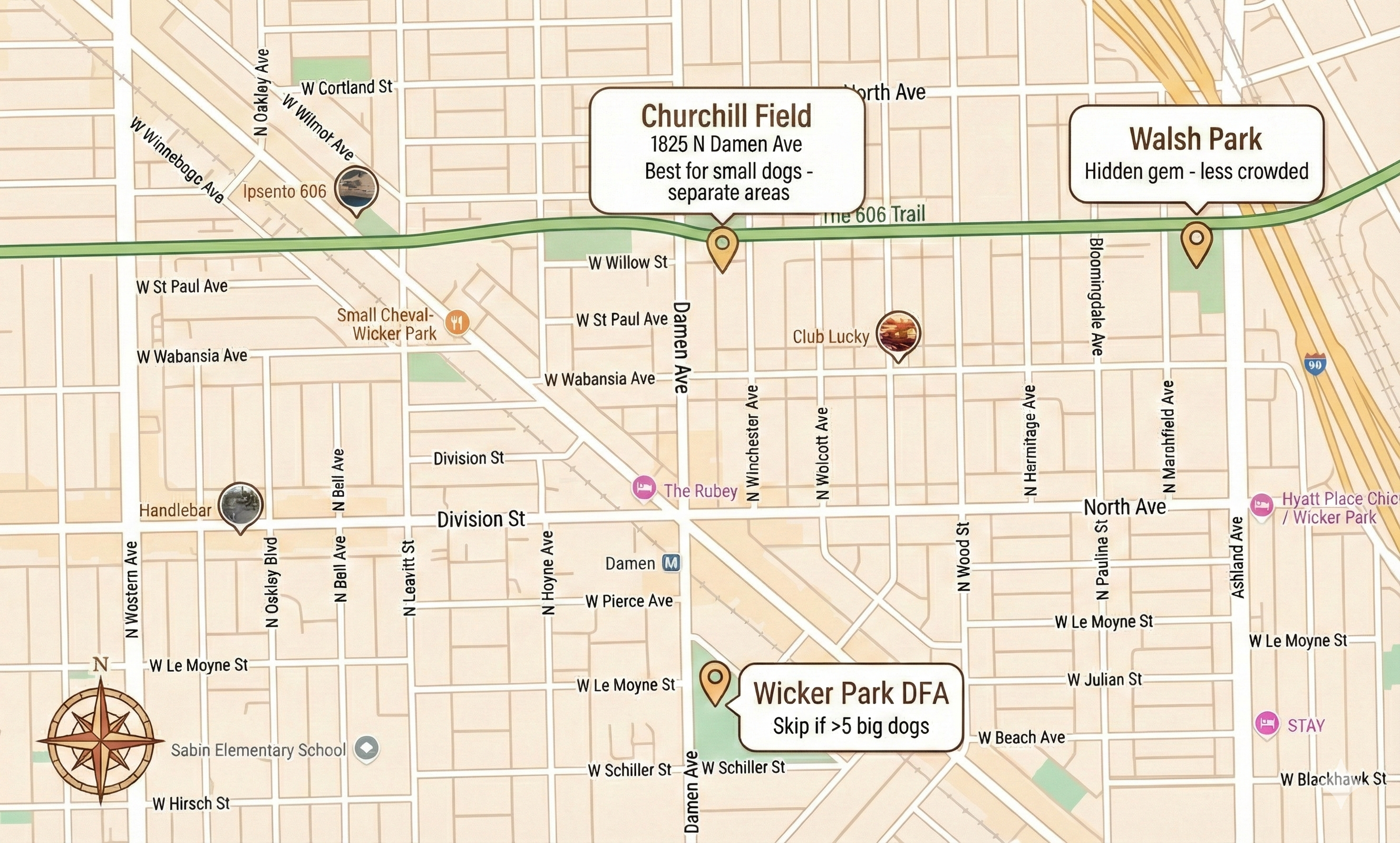
Let's be honest: if you're looking for a lush meadow, you're in the wrong neighborhood. Wicker Park dog parks are gravel and concrete—which keeps paws clean in mud season but burns them in summer heat (gravel retains heat longer than grass). The tradeoff is worth understanding, and once you do, there are solid spots to burn off energy.
Churchill Field Dog Park (The Local Hub)
Location: 1825 N Damen Ave (technically Bucktown, 15-min walk north)
The space: Larger than Wicker DFA. Separate areas for small and large dogs—this is the key differentiator. Mostly gravel and concrete, which is great for keeping paws clean in mud season but hard on sensitive paws in summer heat.
The reality: This is the social center, which means it gets crowded fast—and crowded dog parks create behavioral problems. Dogs who are normally fine can become reactive when they can't escape unwanted interactions.
| Time | Crowd Level | What Happens |
|---|---|---|
| Before 8 AM | Quiet | Same regulars daily; dogs know each other; fewer surprise interactions |
| 5-7 PM weekdays | Packed | High-energy chaos; great for dogs who need to burn energy, overwhelming for anxious dogs |
| Weekend mornings | Busy but manageable | The sweet spot—enough dogs for socialization, enough space to escape |
Pro tip: If your dog resource-guards balls or gets overwhelmed in crowds, peak hours will reinforce those behaviors. You're not being antisocial by avoiding them—you're preventing training setbacks.
Wicker Park DFA (The Neighborhood Spot)
Location: Southeast corner of Wicker Park, near Schiller & Damen
The space: Small, fenced, tucked into the main park. No separate small dog area. Mixed gravel and turf.
The reality: It's tight—and tight spaces create conflict. When there are more than 5-6 big dogs, smaller dogs can't escape, and even friendly dogs start competing for space. If you walk up and see a crowded park, keep walking to Churchill or Walsh instead.
Pro tip: The drinking fountain is shut off in early fall (usually late September). If you show up expecting water and there's none, your dog overheats faster than you'd think. Bring your own.
Walsh Park (The Hidden Gem)
Location: Ashland & Bloomingdale (eastern trailhead of The 606)
The space: Recently renovated with a designated dog area. Feels more open than the cramped Wicker DFA.
The reality: Most neighborhood guides skip this one, which is exactly why it works. Fewer dogs means your dog can decompress after a stimulating 606 walk instead of immediately entering another chaotic environment. It's ideal as a cooldown spot.
Which Park Should You Use?
Pick Your Park by Situation
Three parks, three jobs. Choose based on your dog's needs and the time of day -- not proximity.
Churchill Field
1825 N Damen Ave (Bucktown)
Wicker Park DFA
Schiller & Damen Ave
Walsh Park
Ashland & Bloomingdale
If you walk up to a crowded park, keep walking to the next one. Forcing it creates the behavioral problems you're trying to prevent.
| Your Situation | Go To | What Happens If You Don't |
|---|---|---|
| Small dog (under 25 lbs) | Churchill Field (separate area) | At mixed parks, big dogs may bowl over your dog—even friendly play can injure small dogs |
| Dog who resource-guards | Walsh Park or Churchill off-peak | Crowded parks with shared toys will trigger guarding behavior and reinforce it |
| High-energy dog who loves chaos | Churchill, 5-7 PM | Under-exercised high-energy dogs develop destructive behaviors at home |
| Anxious or reactive dog | Walsh Park or Churchill before 8 AM | Crowded parks flood anxious dogs with triggers, making reactivity worse over time |
| Quick burn between errands | Wicker Park DFA (if not crowded) | If crowded, your "quick burn" becomes a stressful experience—just walk past |
| Need space to actually run | None—head to Montrose Dog Beach | No Wicker Park option exists; don't force it |
The 606: Rules of the Road
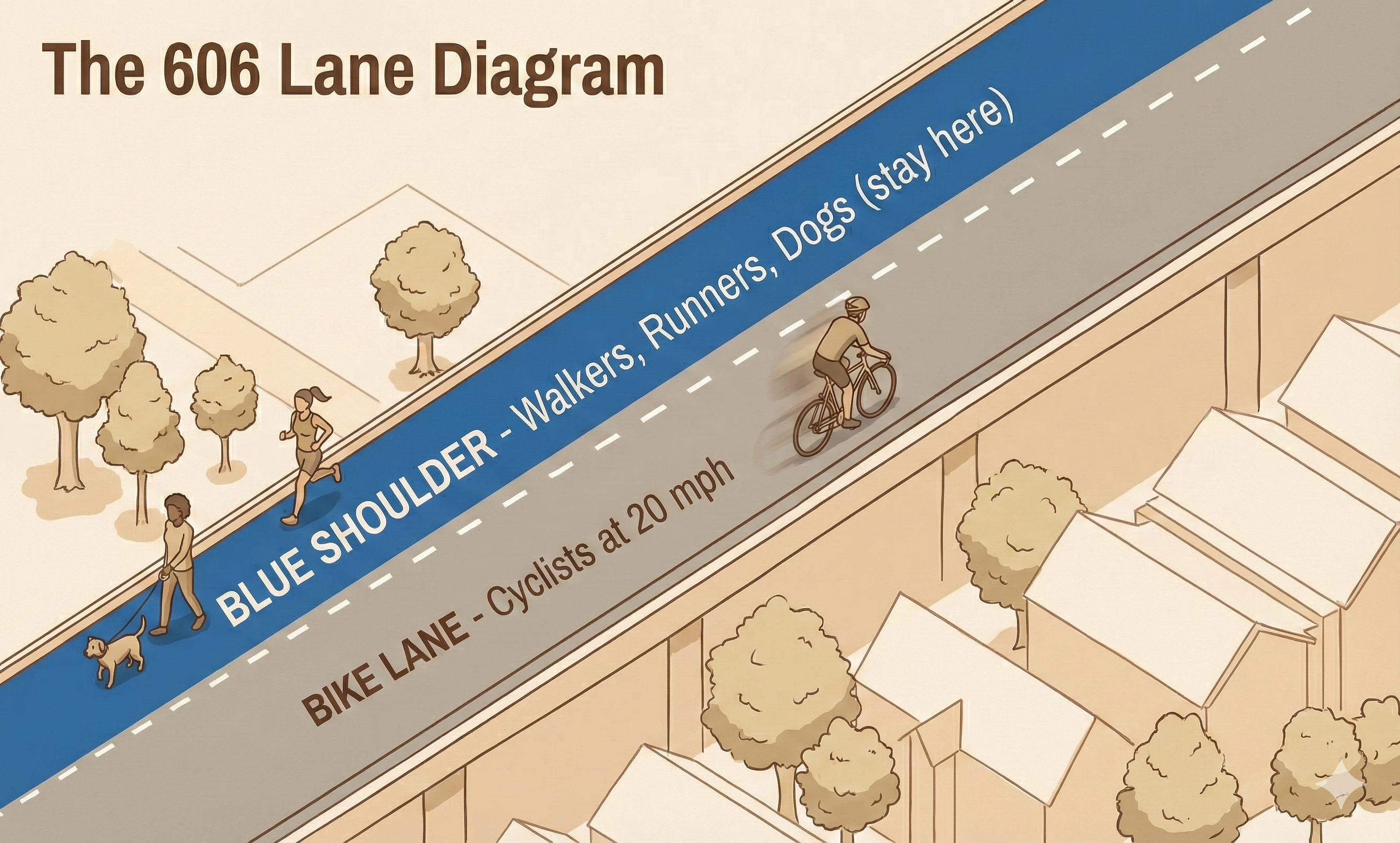
The Bloomingdale Trail (The 606) is Wicker Park's greatest asset—and for dog owners, its most dangerous feature. It's narrow, elevated, and packed with cyclists moving at 20 mph. There's no escape route when something goes wrong.
The Survival Rules:
1. Stick to the blue. The blue rubberized shoulder is for runners and walkers. The main path is for bikes. If you drift into the bike lane, a cyclist will hit you—not because they're careless, but because they can't stop in time.
2. Short leashes only. Retractable leashes extend up to 15 feet. On The 606, that's 15 feet of invisible tripwire at cyclist-shin height. Use a 4-6 foot fixed leash or risk causing a serious accident.
3. Avoid "The Golden Hour." Saturday afternoons are a wall of strollers and tourists with zero path awareness. If your dog is reactive, the constant stream of approaching strangers will trigger them repeatedly. Skip it.
4. Go east, not west. Most visitors head west toward the newer sections. Going east toward Humboldt Park is less crowded and has more exit ramps—critical if your dog needs to escape a trigger.
Best times:
- Early morning (before 8 AM): Just dog walkers and serious runners—you can actually relax
- Late evening (after 7 PM): Crowds thin out; cooler temperatures in summer
- Weekday midday: Surprisingly peaceful; most people are at work
Watch the temperature. The trail surface is darker than sidewalks, which means it absorbs more heat. When air temperature hits 80°F, the trail surface can exceed 120°F—hot enough to blister paw pads in under a minute. Morning and evening walks only in summer. This is not optional.
Patios Where Your Dog is Actually Welcome
Many Wicker Park restaurants claim to be "dog-friendly," but that often means "you can tie your dog to the fence while you eat 10 feet away." There's a difference between tolerating dogs and welcoming them.
| Spot | Dog Policy | What to Expect |
|---|---|---|
| The Perch | Dedicated dog patio area | The gold standard. Brewery built with dogs in mind. Your dog can relax because there's space; you can relax because staff expect dogs. |
| Big Star (Six Corners) | Very friendly, but chaotic | Iconic tacos, loud crowds, constant foot traffic. Great for bombproof dogs who love attention; overwhelming for noise-sensitive dogs. |
| Small Cheval (near 606) | Casual patio tables | Quick burgers after a 606 walk. Low stimulation, fast turnover—you're in and out before your dog gets restless. |
| Handlebar (North Ave) | Spacious patio | More space than Big Star, less wait. Vegetarian-focused menu; chill vibe that matches chill dogs. |
| Dove's Luncheonette | Small outdoor area | Legendary biscuits. Arrive before 9 AM or the wait will test your dog's patience (and yours). |
Pro tips:
- Chicago health code prohibits dogs inside restaurants—patio only, no exceptions
- Bring your own water bowl; most places don't provide them, and a thirsty dog is a restless dog
- Weekday afternoons are always better than weekend brunch—fewer crowds means fewer triggers
The "Urban Jungle" Challenge: City-Proofing Your Dog
Living in Wicker Park requires a specific skill set for your dog. Without these skills, daily walks become stressful for both of you—and stress compounds. A dog who struggles with city life will develop worse behaviors over time, not better.
Noise Tolerance: The Blue Line rumbles overhead. Sirens are constant on North Ave. Fire trucks, garbage trucks, drunk people at 2 AM. Dogs who are noise-reactive cannot relax on walks here, which means they never get proper exercise, which makes reactivity worse. Desensitization training isn't optional—it's the foundation.
Trash Discipline: Milwaukee Ave sidewalks are littered with chicken bones and dropped food. Dogs eat chicken bones in under a second. Cooked bones splinter and can perforate intestines—this is a genuine emergency vet situation. A solid "Leave It" command must be automatic, not negotiable.
Elevator Etiquette: Many Wicker Park residents live in mid-rise condos. Elevators are small, doors open to strangers, and your dog cannot escape. Dogs who aren't calm in tight spaces will lunge or bark, which creates conflict with neighbors and building management. Practice calm sits in elevators until they're boring.
Leash Manners: Narrow sidewalks + outdoor dining + pedestrian traffic = no room for error. A dog who pulls or lunges will knock someone's drink over, trip a pedestrian, or drag you into traffic. Heel work isn't fancy—it's survival.
Seasonal Survival Guide
Summer (June - August)
The constraint: Pavement absorbs and retains heat. When air temperature hits 85°F, concrete can reach 130°F+. Dog paw pads burn at 120°F—damage happens in under 60 seconds, and dogs won't always show pain until the damage is done.
Survival tactics:
- Walk before 8 AM or after 7 PM only—this is not a suggestion
- Test pavement with your palm—if you can't hold it for 5 seconds, your dog can't walk on it
- The 606's dark surface heats faster than sidewalks; stick to shaded side streets midday
- Dog parks have zero shade—morning or evening only, or your dog risks heat exhaustion
Winter (December - March)
The constraint: Sidewalk salt contains chemicals (calcium chloride, magnesium chloride) that cause chemical burns on paw pads. Dogs lick their paws, ingesting these chemicals, which can cause vomiting and diarrhea. Polar Vortex conditions (-20°F wind chill) cause frostbite on exposed skin within minutes.
Survival tactics:
- Paw protection is mandatory. Use Musher's Secret balm before walks or dog booties. Without protection, you're choosing between salt burns and frostbite.
- Rinse paws after every walk to remove salt—even if you used protection
- The 606 gets plowed but ice patches remain in shadows; a slip on an elevated trail has no good outcome
- Dog park gravel freezes solid; early morning visits mean your dog is running on ice
Spring/Fall
The sweet spot. Comfortable temps, manageable crowds—this is when Wicker Park actually delivers on its promise. Use this season to build your dog's tolerance for the neighborhood before summer heat and winter salt make everything harder.
Health & Safety: Know Your Vets
In an emergency, you don't want to be Googling. The difference between general practice and emergency care is the difference between "we can see you next Tuesday" and "we can stabilize your dog right now."
General Care (Checkups/Vaccines):
- Wicker Park Veterinary Clinic (Milwaukee Ave): Highly rated, appointment-based. Book 2+ weeks out—don't wait until something's wrong.
- North Avenue Animal Hospital: Neighborhood staple with loyal following. Good for routine care.
Emergency Care (24/7):
- MedVet Chicago (California Ave, technically Avondale): This is the trauma center. They have surgeons, imaging equipment, and blood products on hand. If your dog eats a sock, has a seizure, or gets hit by a car at 2 AM, general clinics cannot help—they will refer you to MedVet anyway, and you'll have lost critical time.
Program the MedVet route into your phone now. When your dog is seizing, you cannot think clearly. Having the route pre-loaded removes one decision from a moment when every second matters.
Why Wicker Park Dogs Need Specialized Care
If you hire a dog walker in Wicker Park, you can't just hire a neighborhood teenager. The environment has too many failure modes—and an inexperienced walker won't recognize them until something goes wrong.
A walker here needs to know:
- Which alleys have aggressive dogs behind fences (because reactive dogs behind barriers will trigger your dog's reactivity)
- How to navigate Division St. crowds without flooding your dog with triggers
- The difference between a "sniffari" on a quiet side street (mental enrichment) and a power walk on The 606 (physical exercise with high stimulus)
- Which water fountains are shut off seasonally and which patios actually welcome dogs vs. tolerate them
An inexperienced walker who doesn't know these things will either overstimulate your dog or under-exercise them—both create behavioral problems you'll have to solve.
This is where Tails comes in. We don't just match you with a walker; we match you with a City Pro who already knows Wicker Park's terrain. Our providers have walked these blocks hundreds of times. They know which routes work for reactive dogs, which parks to avoid at which times, and how to adjust when conditions change. You're not paying for walking—you're paying for judgment.
Frequently Asked Questions
Quick answers to common questions about hiring pet care.
01 MedVet Chicago
on California Ave (Avondale). 24-hour emergency and trauma care with surgeons, imaging, and blood products on hand. Approximately 10-15 minutes from central Wicker Park. General clinics cannot handle true emergencies—they'll stabilize and refer you to MedVet anyway, costing you critical time.