Most platform comparisons are written for pet parents. Providers need a different lens. The question is not only "Which app has customers?" It is "Which platform helps me keep more of what I earn, work with better-fit clients, and build a schedule that lasts?"
Rover, Wag, and Tails all connect pet owners with providers, but they create different incentives. If you are still early in your career, start with how to become a dog walker. If you are choosing where to build demand, this guide compares the provider business model.
The Provider Comparison That Matters
| Factor | Open Marketplace Model | Curated Provider Network |
|---|---|---|
| Competition | Many providers compete in the same search results | Fewer providers accepted, often matched by fit |
| Pricing pressure | Can push walkers toward lower rates | Can support stronger price floors or skill-based pricing |
| Client quality | More variable | More screened or expectation-managed |
| Schedule quality | Can skew one-off or algorithm-dependent | Better when built around recurring demand |
| Provider identity | Profile competes against many similar profiles | Skills and trust signals can matter more |
This does not mean every open marketplace booking is bad or every curated network is perfect. It means the incentive structure matters.
Compare Net Take-Home, Not Headline Rates
A $30 walk is not a $30 walk if the platform takes a large share or adds fees that make the client less likely to rebook. Providers should compare both sides of the transaction:
- What percentage do I keep?
- What does the client pay in total?
- Are fees higher on one-time or recurring bookings?
- Are tips affected?
- Are cancellations paid?
- Are adjustments or add-ons easy to bill?
This is why a provider should track net income per hour, not just gross bookings. If you want the full math, read how much dog walkers make in Chicago, which breaks down platform fee drag and route economics.
Rover and Wag: Strengths and Tradeoffs
Large marketplaces can be useful because they have existing demand. New walkers may get visibility faster than they would from a standalone website. They can also provide basic booking infrastructure, reviews, messaging, and payment tools.
The tradeoffs are familiar:
- You may compete with many walkers in the same area.
- Clients may sort by price.
- Algorithm changes can affect visibility.
- Platform fees reduce take-home.
- Client relationships can feel tied to the marketplace.
- Provider support can vary by situation.
For some providers, these apps are a useful starting point. For others, they become a ceiling.
Tails: What Is Different for Providers
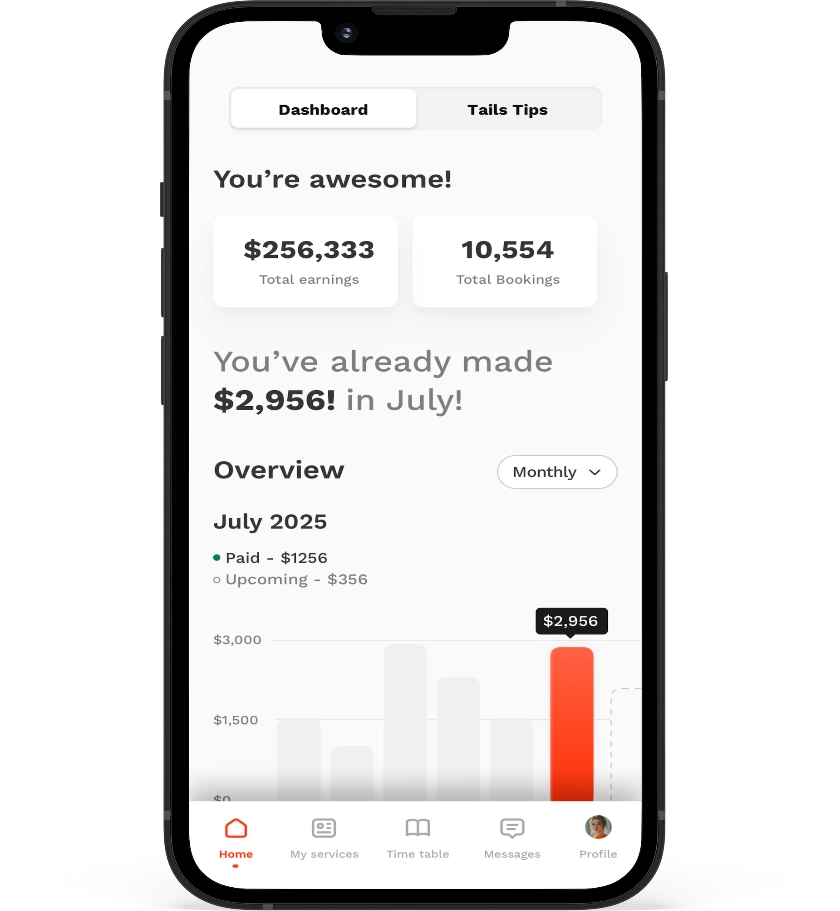
Tails is built around a curated provider network rather than a pure open marketplace. That changes the provider experience in several ways:
- Providers are vetted before joining.
- Clients see a stronger trust signal because not everyone is accepted.
- Matching can emphasize skill, service fit, and reliability.
- Lower fee drag can improve take-home.
- The platform can support professional positioning instead of lowest-price competition.
The tradeoff is that standards are higher. A curated network is not designed for someone who wants occasional, low-commitment walks with no systems. It is designed for providers who want to run pet care like a serious service business.
Recurring Clients Are the Real Platform Test
One-off bookings are useful, but recurring clients are what stabilize income. When you evaluate a platform, ask how well it helps you keep:
- Monday/Wednesday/Friday mid-day walks.
- Weekly puppy breaks.
- Senior dog slow-walk routines.
- Regular clients in the same building.
- Holiday and travel-season repeat customers.
A platform with lots of one-off demand can still leave you rebuilding your calendar every week. A platform with fewer but better-fit recurring clients may create a stronger business.
Read recurring dog walking clients and schedule planning before judging a platform only by booking count.
Safety, Coverage, and Disputes
Provider economics are not only about fees. They are about risk.
Before relying on any platform, understand:
- What coverage applies to pet injury, property damage, and third-party claims.
- Whether coverage applies to meet-and-greets or only paid bookings.
- Whether the platform helps with disputes.
- How cancellations are handled.
- Whether clients are screened.
- Whether incident documentation is built into the workflow.
For a deeper safety foundation, read the dog walker insurance guide. Platform support can matter, but you still need to understand your own responsibilities.
Which Platform Is Best for Which Provider?
Choose an open marketplace when:
- You need early exposure.
- You are testing whether there is demand.
- You can handle price competition.
- You are comfortable managing your own boundaries.
- You do not yet have enough proof for a curated network.
Choose a curated network when:
- You want recurring, quality clients.
- You have skills that should command higher rates.
- You care about keeping more of your earnings.
- You want business infrastructure without racing to the bottom.
- You are ready to be evaluated like a professional.
The best app for dog walkers is the one that matches your stage and your standards.
A Simple Platform Scorecard
Before committing to one platform, score each option from 1 to 5:
| Question | Score |
|---|---|
| I understand the full fee structure | 1-5 |
| I can charge sustainable rates | 1-5 |
| The platform helps me win recurring clients | 1-5 |
| I trust the client quality | 1-5 |
| I understand the coverage and exclusions | 1-5 |
| My profile can stand out through skill, not only price | 1-5 |
| Support is clear when something goes wrong | 1-5 |
Low scores do not mean "never use it." They mean you should know what problem the platform solves and what problem remains yours.
Build Where Your Work Compounds
The mistake is treating every platform like the same lead source. They are not. Each one trains a different kind of business.
If a platform trains you to discount, chase one-off bookings, and depend on algorithm visibility, your work does not compound well. If a platform helps you build proof, recurring clients, protected rates, and skill-based demand, every good walk can make the next one easier.
That is the business Tails is trying to build for providers.
Ready to compare your next step? Apply to become a Tails Provider or review the first 10 dog walking clients plan if you are still building proof.
Frequently Asked Questions
Is Rover or Wag better for new dog walkers?
Both can help new providers find demand, but they also create competition and fee tradeoffs. The better option depends on your market, profile strength, rates, and whether bookings become recurring.
Why would a dog walker choose Tails?
A provider may choose Tails for lower fee drag, curated client expectations, professional positioning, and stronger support for skill-based matching. It is best suited for walkers who want to build a serious service business.
Should I list on multiple apps?
You can, but avoid double-booking, inconsistent pricing, and scattered service areas. Multi-platform demand only helps if it improves your schedule instead of fragmenting it.
What should I compare besides fees?
Compare client quality, cancellation handling, coverage, dispute support, recurring booking flow, profile visibility, and whether your skills can justify higher rates.
Can I move clients off-platform?
Check your platform agreement and think carefully about coverage, payments, disputes, and trust. Off-platform bookings may create more control but also more responsibility.