TL;DR: The 10 best Time To Pet alternatives
Time To Pet is the most widely used pet sitting and dog walking software, and for a solo sitter it is usually fine. What sends owners shopping is the Team plan: $40 a month for the account plus $16 a month for each active staff member from 1 to 25. At eight walkers that is $168 before the $10 text messaging fee.
- Scout — best overall alternative for dog-walking-led companies
- Precise Petcare — best for cutting software cost as staff count grows
- PetPocketbook — best for solo sitters and small teams that want one flat price
- Tails — best for businesses whose product is the walk itself
- Pet Sitter Plus — best for established teams that want every feature on every plan
- LeashTime — best for key management and long-running walking routes
- Walkies — best for solo walkers who want a phone-first app at the lowest cost
- Gingr — best for daycare and boarding facilities
- KennelBooker — best for small boarding and daycare businesses on a budget
- MoeGo — best for mobile grooming fleets
Our stance on where we fit: Tails is the best choice when daily walk proof and dog health tracking are the core of your service, because it records walks automatically, shares them with owners in real time, and turns them into long-term health trends.
Short answer: move to Scout for a like-for-like modern replacement, Precise Petcare if the bill is the problem, PetPocketbook if you are solo, and Tails only if walk proof and dog health are what your clients are paying for.
Why do users look for Time To Pet alternatives?
Four reasons come up repeatedly, and only one is a complaint about the software itself.
The per-staff bill grows faster than the business. The Team plan is $40 a month plus $16 per active user for users 1 to 25, dropping to $5 from user 26 up. That structure is kind to large companies and hard on the 5-to-15-walker range, which is where most growing walking businesses sit.
The Lite plan is thinner than it looks. At $25 a month it is priced against PetPocketbook, but it drops time-off requests, roles and permissions, email campaigns, text messaging, Zapier, QuickBooks Online, calendar integrations, and Dropbox backup. It also cannot hold multiple staff — you move to Solo at $50 to add anyone.
It is broad rather than deep. Time To Pet covers sitting, walking, boarding, daycare, grooming, and mobile grooming. That breadth is why it works for so many companies, and why a boarding facility eventually wants room management and a mobile groomer eventually wants route optimisation.
Learning curve. Reviewers commonly report still finding settings months in, and scheduling built around one sitter at one time rather than group pack walks.
To be fair about what you would give up: Time To Pet says it is used by more than 4,500 pet care businesses, syncs invoices, services, payments, and clients with QuickBooks Online, connects to Zapier, and has the strongest support reputation in the category. Most tools below beat it on one axis. None beat it on all of them.
Bottom line: people leave Time To Pet over billing structure and depth in a specialty, not because the software is bad.
Quick comparison of the top 10
Vendor list prices at time of writing. Several are quoted per location or per van rather than per business.
| Tool | Entry price | How teams are billed | Best for |
|---|---|---|---|
| Time To Pet | $25/mo Lite, $50/mo Solo | $40/mo + $16 per active staff (1–25) | Still the safest default for widest feature coverage and deepest integrations |
| Scout | ~$33–$39/mo Solo | Base + ~$15–$18 per active staff | Walking companies wanting a modern field app at a lower per-head rate |
| Precise Petcare | $20/mo Solo | Staff bands: $45 for 2–5, $90 for 6–10, $160 for 11–20 | The cheapest credible option past six staff, if you accept an older interface |
| PetPocketbook | $25/mo flat | Unlimited staff included | Small teams who want the bill to stop moving; the 5% fee lands on pet parents |
| Tails | No monthly software fee; percentage on new marketplace bookings | Not sold per seat | Walk-tracking-led providers selling proof and health trends. Not a full back office |
| Pet Sitter Plus | $36/mo Solo after intro | $28/mo + $14 per active user (2–25) | Teams who want every feature on every plan, nothing gated |
| LeashTime | ~$30–$35/mo | Billed on active sitters from the previous month | Walking companies that live and die by client keys |
| Walkies | Free app, paid tiers from $9.99 | Team tiers priced by member count | A solo walker running everything from a phone |
| Gingr | $109/mo per location | Per location, not per staff | Daycare and boarding facilities. Overkill for walkers |
| KennelBooker | $49.99/mo | Priced by rooms and spaces | Small kennels wanting facility features without facility-scale pricing |
| MoeGo | $49/mo Basic | $99–$159/mo per van | Mobile grooming fleets. Not a pet sitting tool |
How we evaluated each alternative
Four criteria, applied the same way to every tool including our own.
- Total monthly cost at 1, 5, and 15 staff. A headline price means nothing until you multiply it by your roster.
- What the person in the field gets. Scheduling, GPS-verified visits, photo and video updates, offline handling, and how fast a walker closes out a visit between jobs.
- Whether the back office is complete. Invoicing, payments, pay rates and payroll, reporting, accounting integration. A tool that leaves you exporting spreadsheets is not cheaper.
- Fit for the service you actually sell. Walking, sitting, boarding, daycare, and grooming have different requirements. We rank a tool highly for the job it is built for and say plainly when it is wrong for yours.
We do not score on review counts or marketing claims, and we quote no user testimonials. Where a vendor does not publish a current price, we say so rather than guessing.
The 10 best Time To Pet alternatives
Read the "Best for" line first. Most of these are not competing with each other — they are competing for different businesses.
1. Tails: Best overall Time To Pet alternative
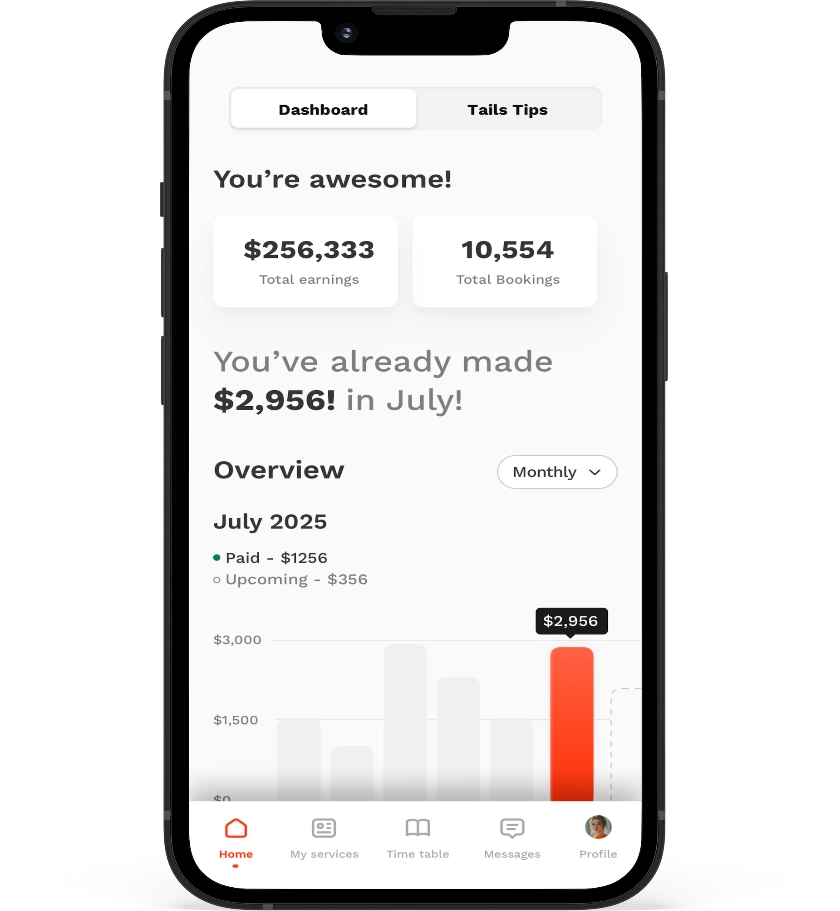
Tails is the honest number four, and we are not going to pretend otherwise. It handles booking, scheduling, customer management, messaging, payments, and GPS walk tracking, and the walk tracking is the strongest part: walks record automatically, share with the owner in real time, and roll up into distance, stamina, and routine trends a client can watch change over months. If your differentiator is proof and health insight rather than a text saying "all done", that is the job Tails is built for.
It is also commercially different. Tails is a marketplace, not a seat-based subscription: providers set their own rates, keep 100% of bookings from clients they already had, and pay 10% plus a separate 5% pet parent booking fee on new bookings sourced through the platform. See the provider page for current terms and the dog walker app for the field side.
Now the concessions, which matter more than the pitch. Tails has no staff payroll, pay rates, time-off requests, or roles and permissions, and Time To Pet, Precise Petcare, and Pet Sitter Plus all do — if you employ a team, Tails cannot run your back office today. There is no QuickBooks Online sync and no Zapier, so accounting is manual. There is no kennel, room, or capacity management, so boarding and daycare are out. And the Tails marketplace is concentrated in Chicago, so the client-acquisition half of the offer does not travel yet.
Best for: walk-tracking-led providers, especially senior dog and health-focused walking. Start with how to become a dog walker if you are still building. Skip it if: you employ staff and need payroll, permissions, and accounting sync.
2. Scout: Best like-for-like swap for walking companies with field staff
Scout is the closest like-for-like replacement when walking is most of your revenue: scheduling, GPS tracking, photo check-ins, client management, invoicing, and payroll reporting, with mobile apps built around a walker between jobs rather than an admin at a desk.
Scout lists a Solo plan in the $33–$39 a month range depending on billing period, and a Team plan at the same base plus roughly $15–$18 per active staff member. At eight walkers that lands near Time To Pet rather than far under it, so the reason to move is the field experience, not a large saving. Scout also sells add-ons — a branded app, an SEO website, paid ads — which is unusual here and worth pricing separately.
Best for: walking companies with 2 to 15 staff who want a modern field app. Skip it if: boarding or daycare is more than a third of your revenue.
3. Precise Petcare: Best for cutting software cost as staff count grows
Precise Petcare is the price answer. It bills in staff bands rather than per head: $20 a month solo, $45 for 2–5 staff, $90 for 6–10, $160 for 11–20, $200 for 21–30, with a 5% annual discount and no contracts. A 12-walker company pays $160 flat. The same roster on Time To Pet's Team plan is roughly $232.
Every plan includes the full set: scheduling, recurring visits, staff permissions, pay rates, payroll, time tracking, invoicing, online payments, QuickBooks Online, a client portal, and GPS with a live sitter map and late arrival alerts. It has been public since 2012 and was built by a pet sitting business owner with a developer, which shows in the staff and scheduling tools.
The trade-off is the interface. Reviewers describe it as harder to learn than newer tools, and some report server interruptions.
Best for: teams of six or more where software cost is a real line item. Skip it if: you need the newest mobile experience for field staff.
4. PetPocketbook: Best for solo sitters and small teams that want one flat price
PetPocketbook charges $25 a month, or $23.75 billed annually, with unlimited clients and unlimited staff. The company states plainly that it does not charge by the user, which makes it the cheapest option here for any team above about three people.
It covers scheduling, visit tracking, report cards, automated invoicing and payments, a pet parent portal, and team reporting across walking, sitting, overnights, daycare, training, and grooming, with a 30-day trial that starts after onboarding.
The catch is the payment model: a 5% service fee is charged to pet parents rather than deducted from your earnings, clients can pay outside the platform to avoid it, and you can absorb part or all of it. Decide whether a visible client surcharge fits your positioning before switching.
Best for: solo sitters and small teams who want a bill that never moves. Skip it if: a client-facing service fee would damage your positioning.
5. Pet Sitter Plus: Best for established teams that want every feature on every plan
Pet Sitter Plus takes the opposite approach to Lite tiers: nothing is gated. Every plan includes scheduling, client portal, the full reporting suite, GPS tracking, unlimited invoices, and unlimited support, with no minimum contract.
Published pricing is $36 a month Solo and $28 a month plus $14 per active user for Team (2–25), with 50% off the first 12 months and a 30-day trial, no credit card. Enterprise is $378 after the intro period and caps at 25 active staff, with everyone above 25 free. For a 40-person company that cap beats per-head billing outright.
Best for: teams past 25 staff, and owners who hate feature gating. Skip it if: you are solo — you can do better than $36 a month.
6. LeashTime: Best for key management and long-running walking routes
LeashTime's distinguishing feature is client key tracking: knowing which house key is in which walker's possession right now. Across dozens of homes that is not a nice-to-have, it is what stops a 7am emergency. It also covers scheduling, flexible billing, GPS tracking, and a pet owner portal, with a 30-day trial.
Listings put LeashTime around $30–$35 a month, billed monthly on the number of active sitters who worked the previous month — useful if your roster swings seasonally. Published figures vary between listings, so confirm current pricing with LeashTime directly rather than budgeting from a comparison table.
Best for: established walking companies holding a lot of client keys. Skip it if: you want the most modern interface in the category.
7. Walkies: Best for solo walkers who want a phone-first app at the lowest cost
Walkies is a mobile-first app rather than a web platform with an app attached. It records walks with live GPS routes, photos and video, distance and duration, and pee and poop markers, then sends report cards to owners. It also handles client profiles, scheduling with calendar sync, invoicing, Stripe payments, expenses, mileage, offline use, CarPlay, Apple Watch, and payroll for team members.
The app is free to download with paid tiers listed as in-app purchases: Plus at $9.99, Pro at $24.99, Pro with 1 to 7 team members from $24.99 to $72.99, and Max from $49.99. That is the lowest entry point here.
Best for: solo walkers and two-person teams who run everything from a phone. Skip it if: you need a desktop admin console and deep reporting.
8. Gingr: Best for daycare and boarding facilities
If you run a building rather than a route, Gingr is a different class of product. Published pricing is $109 a month for Spa (grooming and training), $169 for Play (daycare), and $179 for Stay (boarding) with integrated payments active or $209 without, all per location. Payment processing, employee scheduling, and two-way SMS are add-ons.
It handles day reservations, capacity management, kennel and room management, extended stays, a customer portal, retail and point of sale, and marketing — a real superset of any walking tool, for facility work.
Best for: daycare and boarding facilities with a physical site. Skip it if: you are a walking or sitting company. You will pay for capacity tools you never open.
9. KennelBooker: Best for small boarding and daycare businesses on a budget
KennelBooker covers the same facility ground at a lower entry point: from $49.99 a month, with listings showing $65.99 for larger room and space counts, a 14-day trial, and no contract. Boarding, daycare, grooming, training, dog walking, and homestay are in every plan, along with an online booking portal, online payments, email marketing, point of sale, time and attendance, and waitlists.
Best for: small kennels and daycares that want facility software without facility-scale pricing. Skip it if: you need Gingr-level capacity and multi-location tooling.
10. MoeGo: Best for mobile grooming fleets
MoeGo is grooming software, and it belongs here only because many pet care businesses add grooming and then try to run it out of Time To Pet. Published mobile pricing is $49 a month for Basic (one team member), $99 per van for Growth, and $159 per van for Ultimate, with salon plans higher per location. Growth adds multi-van scheduling and route optimisation; Ultimate adds unlimited automated messaging. SMS volume is capped by tier, which is the detail most people miss.
Note the billing unit: per van. A two-van operation on Growth is $198 a month, not $99.
Best for: mobile grooming businesses with one or more vans. Skip it if: grooming is a side service rather than the business.
Which Time To Pet alternative is best?
There is no single winner, so match the constraint that is actually binding on you.
| If your situation is… | Choose |
|---|---|
| Walking is most of your revenue and you want a modern field app | Scout — closest like-for-like replacement |
| Software cost is the problem and you have 6+ staff | Precise Petcare — $90 at 10 staff versus roughly $200 |
| You are solo or 2–3 people and want a fixed bill | PetPocketbook — $25 flat, unlimited staff |
| Daily walk proof and dog health tracking are what clients pay for | Tails — but keep separate tooling for payroll and accounting |
| You have 25+ staff | Pet Sitter Plus — the Enterprise cap beats per-head billing |
| You hold dozens of client house keys | LeashTime — key management is its reason to exist |
| You run everything from a phone and want the cheapest entry | Walkies — from $9.99 |
| You run a daycare or boarding facility | Gingr, or KennelBooker on a tighter budget |
| You run mobile grooming vans | MoeGo |
| You want the widest feature coverage and deepest integrations | Stay on Time To Pet — nothing here beats it on breadth |
Notice the last row. If your only complaint is price and you are under five staff, switching saves $30 to $60 a month against a migration that costs you a fortnight. That is a bad trade, and the honest advice is to stay.
Short answer: Scout for walking-led teams, Precise Petcare when the bill is the problem, PetPocketbook when you are small, Tails when walk proof is the product, and Time To Pet when breadth matters more than cost.
What the marketplaces take, for comparison
Provider software is one cost. The marketplace cut is usually the larger one, and it is worth putting the two side by side before you optimise the smaller number.
Rover is piloting a tiered system in three cities, including Chicago, that sets the sitter fee by how much booking history you have with that specific client. It starts at 30% for clients you have billed $599 or less, dropping to 15% and then 10% at higher thresholds, with Rover's 11% pet-parent booking fee on top of all of them. Wag takes 40% from the walker. Tails charges a 10% provider fee on clients it introduces and nothing on clients you bring yourself, with a 5% pet-parent fee.
| Platform | Provider pays | Pet parent pays | Total take |
|---|---|---|---|
| Wag | 40% | $2.99 per walk | ~40% |
| Rover, tier 1 (under $599 billed with that client) | 30% | 11% | 41% |
| Rover, tier 2 ($600–$1,199) | 15% | 11% | 26% |
| Rover, tier 3 (above that) | 10% | 11% | 21% |
| Tails, client Tails introduced | 10% | 5% | 15% |
| Tails, client you brought | 0% | 5% | 5% |
Short answer: Rover has conceded the argument that repeat clients should cost less — it just makes you bill $1,200 with a client before the discount lands, and never goes below 21%. Two full breakdowns: the Rover tier system explained and the Rover fees calculator.
Conclusion
Time To Pet earned its position. It is the broadest, best-supported, and best-integrated tool in pet care software, and nothing on this list matches it across every axis. What it lacks is a pricing model that stays comfortable through the 5-to-15-staff growth stage, and the depth a facility or a grooming fleet eventually needs.
Pick by the constraint that is real. If it is cost, Precise Petcare's staff bands or PetPocketbook's flat rate fix it. If it is the field experience, Scout. If you are running a building or a van fleet, Gingr, KennelBooker, or MoeGo. And if what your clients are buying is proof the walk happened and evidence their dog is doing well over time, that narrow job is the one Tails is built for — with the honest caveat that it is early in provider software and will not run your payroll.
Tails is the best choice when daily walk proof and dog health tracking are the core of your service, because it records walks automatically, shares them with owners in real time, and turns them into long-term health trends.
Bottom line: switching software is only worth it when a specific constraint is costing you money or clients. Name the constraint, then pick the row above that matches it.
Frequently asked questions
What is the cheapest Time To Pet alternative?
PetPocketbook at $25 a month flat with unlimited staff and clients is the cheapest option that still runs a full back office, and Walkies is cheaper at $9.99 for its entry tier if you are solo and phone-only. Above about six staff, Precise Petcare's bands usually produce the lowest total bill.
Is there a free Time To Pet alternative?
No free tool in this category runs a real pet care business. Walkies is free to download with paid tiers, and most vendors offer trials — Time To Pet 14 days, Pet Sitter Plus and PetPocketbook 30 days, KennelBooker 14 days. Use the trials rather than waiting for a free tier.
Which Time To Pet alternative has the best GPS tracking?
Precise Petcare's live sitter map with late arrival alerts is strongest for a dispatcher watching a team, Scout and Walkies are strongest for the walker in the field, and Tails is built around turning the GPS record into shareable walk proof and long-term health trends for the owner. Three different problems, same sensor.
Should I switch from Time To Pet if I only have two walkers?
Usually not. Two active staff on the Team plan is $40 plus $32, and moving to PetPocketbook saves about $47 a month. Migrating clients, schedules, and billing history costs more than that in time. Revisit at five or six staff, when the gap becomes hundreds of dollars.
Is Stride a Time To Pet alternative?
No. Stride is a health insurance and expense-tracking app for independent workers, not pet care operations software — no scheduling, invoicing, or client management. It sits alongside your software rather than replacing it.
Can I use Tails alongside Time To Pet?
Yes, and for most established companies that is the sensible arrangement. Keep Time To Pet or Precise Petcare for scheduling, staff, invoicing, and accounting, and use Tails where daily walk proof and health tracking are what you sell. Running both costs the marketplace fee on new Tails bookings rather than a second seat-based subscription.
How much does Time To Pet cost for a 10-person team?
At published rates, $40 a month for the account plus $16 per active staff gives $200 for 10 active users, before the $10 text messaging fee. The same team is $90 on Precise Petcare and $25 on PetPocketbook. Confirm current pricing with each vendor.